Why Methodology Matters
The word "tailor" is used loosely in Hong Kong. It appears on shopfronts along Nathan Road promising suits in 24 hours, and on the business cards of private cutters who have spent four decades developing their craft. The word alone tells you almost nothing.
What distinguishes a genuinely fine garment from a mediocre one is not the label, the location, or the price. It is methodology — the sequence of decisions, techniques, and standards that govern how a garment is conceived, constructed, and refined. Understanding that methodology is the most reliable way to evaluate any tailor, at any price point.
This guide sets out the methodology that underpins fine tailoring. It is not a ranking of tailors, nor a price comparison. It is a framework for understanding what a well-made garment actually requires — and what questions to ask before you commission one.
Stage One: The Consultation
A serious consultation is not a sales conversation. It is a diagnostic process — an attempt by the cutter to understand not just your measurements, but your body, your lifestyle, and your professional context.
A thorough first consultation will typically last between 45 minutes and an hour. The cutter will ask about the occasions you dress for, the environments you work in, and the garments you already own. They will observe your posture, your natural stance, and any asymmetries in your build. They will ask about your aesthetic preferences — not to flatter you, but to understand the constraints within which they are working.
This stage is where the relationship between client and tailor is established. A cutter who rushes the consultation, who does not ask questions, or who does not listen carefully to the answers is unlikely to produce a garment that genuinely fits. The consultation is the foundation of everything that follows.
For a first commission, it is reasonable to visit two or three tailors for consultations before committing. The quality of the consultation is itself a reliable indicator of the quality of the finished garment.
Stage Two: Measurement and Pattern Cutting
Measurement is the most technically demanding stage of the process, and the one that most clearly separates bespoke from made-to-measure construction.
A made-to-measure service will typically take 15 to 20 measurements and use them to adjust a standard block pattern. The result can be excellent — and is a significant improvement on off-the-rack — but the block pattern imposes its own assumptions about proportion that may not match the individual client.
In true bespoke construction, the cutter takes a comprehensive set of measurements — typically 30 or more — and uses them to draft a pattern from a blank sheet. Every seam line, dart, and ease allowance is calculated specifically for the individual. The cutter accounts not only for size but for posture: a client who carries one shoulder higher than the other, or who stands with a slight forward lean, requires a pattern that accommodates those characteristics rather than ignoring them.
The quality of the pattern is the single most important determinant of fit. A garment cut from a poor pattern cannot be corrected at the fitting stage — the errors are structural. A garment cut from a precise pattern, by contrast, will require only minor refinements at the fitting.
Stage Three: The Basted Shell
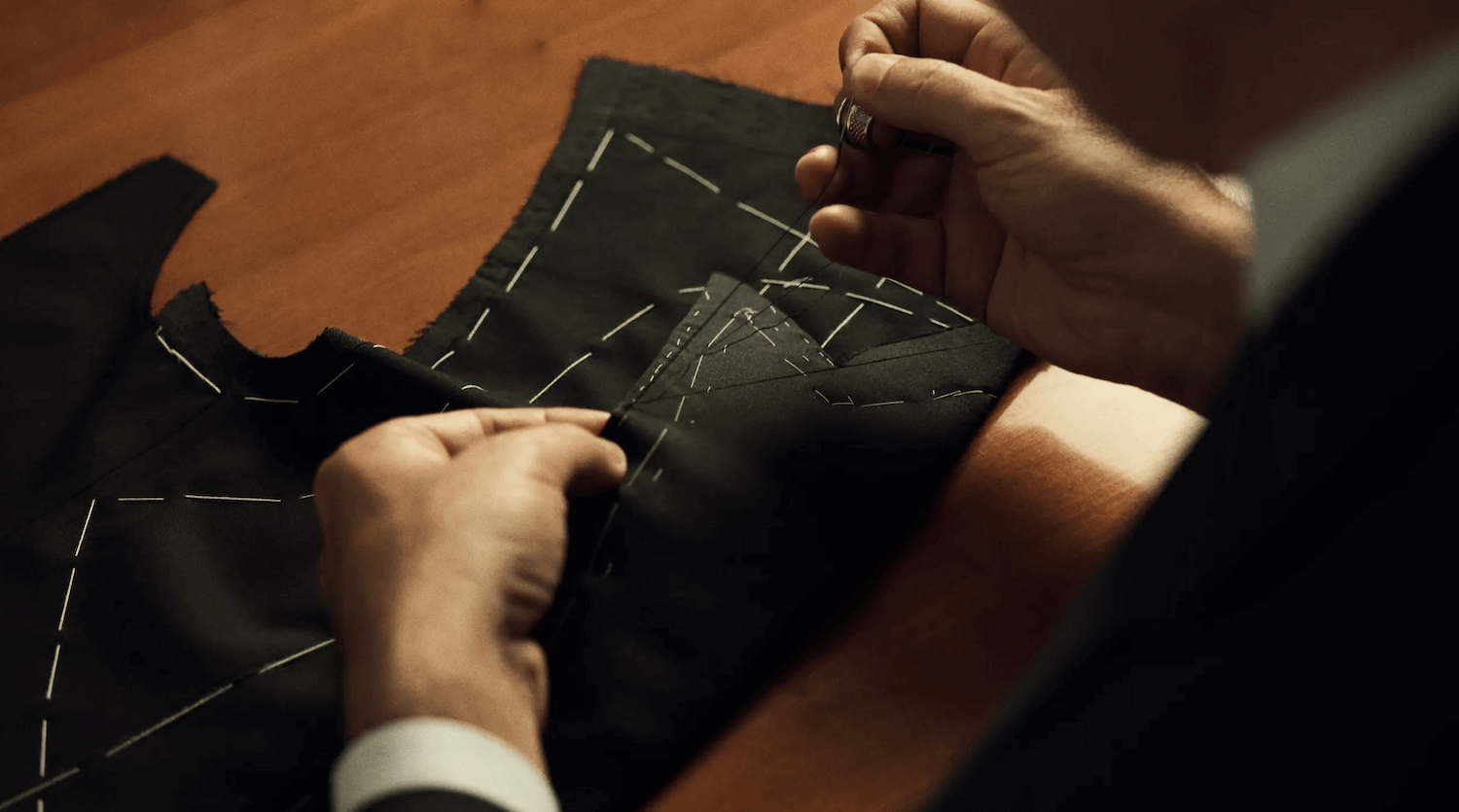
Before the final fabric is cut, a bespoke tailor will construct a basted shell — sometimes called a toile — from an inexpensive cloth. This shell is assembled loosely, with long temporary stitches, and worn by the client at the first fitting.
The purpose of the basted shell is to test the pattern before committing to the final fabric. It allows the cutter to assess the fit in three dimensions — on the client's body, in motion — and to identify any adjustments required before a single cut is made in the cloth that has been selected.
This stage is the most reliable indicator of whether a tailor is genuinely working to bespoke standards. Many establishments that market themselves as bespoke do not produce a basted shell — they cut directly into the final fabric and make adjustments at the fitting. This is not bespoke construction. It is a made-to-measure process using bespoke language.
The basted shell fitting is also the stage at which the client's input is most valuable. This is the moment to raise any concerns about the proposed silhouette, the position of the pockets, or the length of the jacket. Changes made at this stage cost nothing. Changes made after the final fabric has been cut are expensive and sometimes impossible.
Stage Four: Construction and Canvassing
Once the pattern has been confirmed, the final fabric is cut and construction begins. The most important technical decision in this stage is the interlining — the internal structure that gives the jacket its shape and drape.
A fused jacket bonds its interlining to the outer fabric using heat and adhesive. This is the standard construction method for the majority of suits sold globally. It is fast, inexpensive, and produces a consistent result — but it also produces a jacket that feels stiff, does not breathe well, and tends to delaminate over time, particularly in humid climates.
A canvassed jacket uses a woven interlining — traditionally horsehair canvas — that is hand-padded to the shape of the wearer's chest. This canvas is not bonded to the fabric. It floats between the outer cloth and the lining, held in place by the tailor's stitching. Over time, as the jacket is worn, the canvas moulds to the contours of the wearer's body. The result is a garment that improves with wear — that becomes, over months and years, increasingly personal.
Full canvas construction, in which the canvas extends through the entire front of the jacket, is the standard for genuine bespoke. Half canvas, in which the canvas covers only the chest and lapels, is a practical and legitimate compromise for made-to-measure garments. Fused construction has no place in a garment that is marketed as bespoke.
Stage Five: Hand-Finishing
The degree of hand-finishing in a garment is the most visible expression of the tailor's craft — and the most reliable indicator of quality for the informed observer.
The lapels of a well-made jacket are hand-rolled: the tailor folds and stitches the lapel by hand, creating a natural roll that follows the curve of the chest. A machine-pressed lapel lies flat against the jacket front in a way that is immediately recognisable to anyone who knows what to look for.
The buttonholes of a bespoke jacket are hand-sewn — a technique that requires significant skill and time, and produces a result that is both more durable and more refined than a machine-cut buttonhole. The pick-stitching along the lapel edges, if present, should be executed by hand in a thread that is slightly heavier than the cloth, creating a subtle visual texture.
The sleeve head — the point at which the sleeve is attached to the jacket body — is one of the most technically demanding elements of jacket construction. In a well-made garment, the sleeve head is hand-sewn with a slight ease that allows the sleeve to hang naturally from the shoulder. In a poorly made garment, the sleeve is set mechanically, often producing a pulling or puckering at the shoulder point.
These details are not merely aesthetic. They are structural — they determine how the garment moves, how it holds its shape, and how long it lasts.
Stage Six: The Fitting Process
A bespoke garment requires a minimum of two fittings after the basted shell — typically a forward fitting, at which the garment is partially assembled, and a final fitting, at which it is complete. Some cutters prefer three or four fittings, particularly for a first commission.
The fitting is a collaborative process. The client's role is to wear the garment naturally — to stand, sit, and move as they would in daily life — and to communicate honestly about any areas of discomfort or dissatisfaction. The tailor's role is to observe, diagnose, and adjust.
A skilled cutter will assess the garment from every angle, looking for signs of strain, pulling, or imbalance. They will check the position of the collar, the roll of the lapel, the hang of the sleeve, and the break of the trouser. Each adjustment is marked in chalk and transferred to the pattern for future commissions.
The fitting is also the stage at which the client's eye is most valuable. If something does not look right — if the jacket feels too long, or the trouser break is not what was discussed — this is the moment to say so. A good tailor will welcome the feedback. The fitting is not a formality; it is the mechanism by which the garment is refined.
The Standard to Expect
Fine tailoring is not defined by price alone. It is defined by the rigour of the process — the quality of the consultation, the precision of the pattern, the integrity of the construction, and the patience of the fitting process.
A garment that has been through this process — genuinely bespoke, properly canvassed, carefully fitted — will serve its owner for decades. It will improve with wear. It will hold its shape through a full working day in Hong Kong's humidity. It will fit in a way that no off-the-rack garment ever can.
The methodology described in this guide is not a luxury reserved for a small elite. It is the standard that any professional commissioning a tailored garment has the right to expect — and the standard against which any tailor should be willing to be measured.
When you understand what fine tailoring actually requires, you are in a position to ask the right questions, to recognise the right answers, and to invest your money with confidence.
Ready to Commission
Begin Your Tailoring Journey
Consultations are complimentary and by appointment only.