The Problem of Definition
The word "bespoke" has been so thoroughly diluted by marketing that it has become almost meaningless in casual usage. Airlines offer bespoke travel experiences. Hotels offer bespoke concierge services. In tailoring, the term is applied to everything from a genuinely hand-crafted garment cut from a unique paper pattern to a factory-made suit with a few measurements taken at the point of sale.
In Hong Kong, where the tailoring industry ranges from the finest ateliers to the most aggressive tourist-trade operators, the ability to distinguish genuine bespoke work is a practical skill. This guide sets out the hallmarks of true bespoke tailoring — the construction details, the fitting process, and the practical tests that allow you to assess what you are actually buying.
The Pattern
The first hallmark of true bespoke tailoring is the pattern. In genuine bespoke, a unique paper pattern is cut for each client, based on their measurements and the cutter's observations of their posture and proportions. This pattern is the intellectual property of the house and is retained for future commissions.
In made-to-measure, by contrast, an existing block pattern is adjusted to the client's measurements. The adjustments may be extensive — a good MTM system can account for many variations — but the starting point is a standard template, not a unique pattern. The difference matters most for clients with unusual proportions or significant postural asymmetries, for whom a block-based system will always be a compromise.
Ask the tailor directly: do you cut a unique pattern for each client? A reputable bespoke house will answer yes without hesitation.
Canvas Construction
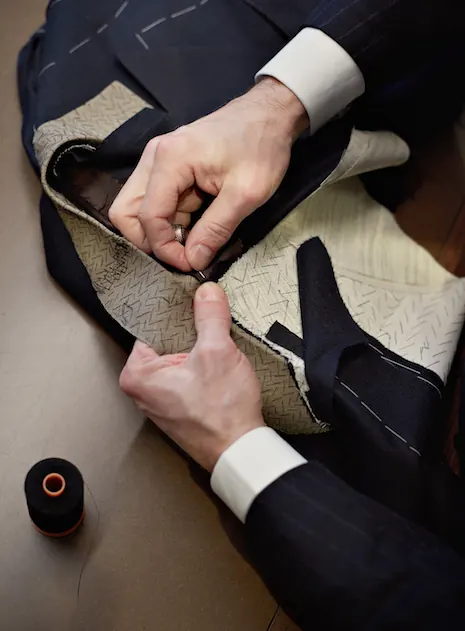
The second hallmark is the construction of the chest. In a genuine bespoke suit, the chest is supported by a floating canvas — a layer of horsehair canvas that is hand-padded to the underside of the front of the jacket. This canvas is not glued; it is stitched, in a process called pad-stitching, in which hundreds of tiny hand stitches attach the canvas to the wool interlining. The result is a chest that is firm but responsive — it moves with the body, breathes with it, and over time moulds to the wearer's chest.
In a fused suit, the chest is supported by a layer of adhesive interlining that is bonded to the outer cloth under heat and pressure. Fusing is faster and cheaper than canvas construction, but it produces a stiffer, less responsive chest that does not breathe and will eventually delaminate — the adhesive bond fails, producing a bubbled or puckered appearance.
To test for canvas construction, pinch the lapel between your thumb and forefinger and roll it gently. In a canvassed suit, you will feel three distinct layers — the outer cloth, the canvas, and the lining — moving independently. In a fused suit, the layers will feel bonded together and will not move independently.
Hand-Stitching and Finishing
The third hallmark is the degree of hand-stitching. In a true bespoke suit, the following elements are typically hand-sewn: the lapel pad-stitching, the collar attachment, the sleeve attachment, the buttonholes, the pick-stitching along the lapel and pocket edges, and the lining attachment. The degree of hand-work varies between houses and traditions — a Neapolitan suit will typically have more hand-sewing than a Hong Kong suit, which in turn will have more than a standard MTM garment.
Buttonholes are a reliable indicator. A hand-sewn buttonhole has an irregular, slightly uneven appearance that is the result of being worked by hand. It is finished with a small bar tack at one end and a keyhole at the other. A machine-sewn buttonhole is perfectly regular and uniform. Run your finger along the edge of the buttonhole: a hand-sewn buttonhole has a slightly raised, textured edge; a machine-sewn one is flat and smooth.
Pick-stitching — the row of small, visible hand stitches along the edge of the lapel and pocket flaps — is another indicator. In the finest bespoke work, this stitching is done by hand and is slightly irregular. Machine pick-stitching is perfectly regular.
The Fitting Process
The fourth hallmark is the fitting process. True bespoke tailoring involves at least two fittings: a basted fitting, in which the garment is assembled in a temporary state with long, easily removed stitches, and a forward fitting, in which the corrections from the basted fitting have been incorporated and the garment is closer to its finished state. Some houses require three or more fittings for a first commission.
The basted fitting is the critical one. It is at this stage that the cutter observes how the garment sits on the body, identifies any fit issues, and marks the corrections. A client who accepts a suit without a basted fitting — or who is told that fittings are not necessary — is not receiving true bespoke service.
The fitting process is also where the relationship between client and tailor is established. A good cutter will ask questions about how the client intends to wear the suit, what activities they will perform in it, and what their aesthetic preferences are. They will offer guidance on cloth, construction, and detail. They will listen.
Practical Tests
Beyond the construction details, there are practical tests you can apply when assessing a finished suit.
The shoulder test: Place your hand flat on the shoulder of the jacket. The shoulder should lie flat and smooth, with no pulling or bunching. A well-cut shoulder follows the natural line of the shoulder without distorting it.
The collar test: The collar should sit flat against the back of the neck with no gap. A gap between the collar and the neck — known as collar stand — indicates a fit issue that a skilled cutter will have addressed.
The chest test: Button the jacket and stand naturally. The chest should lie flat with no pulling across the button. There should be enough ease to move comfortably but not so much that the jacket hangs away from the body.
The seat test: Sit down in the jacket. A well-cut jacket will accommodate the movement of sitting without pulling across the back or riding up at the collar. The back should remain smooth.
The movement test: Raise your arms to shoulder height. The jacket should rise with the arms but return to its natural position when the arms are lowered. If the jacket stays raised, the armhole is too low.
Ready to Commission
Begin Your Tailoring Journey
Consultations are complimentary and by appointment only.