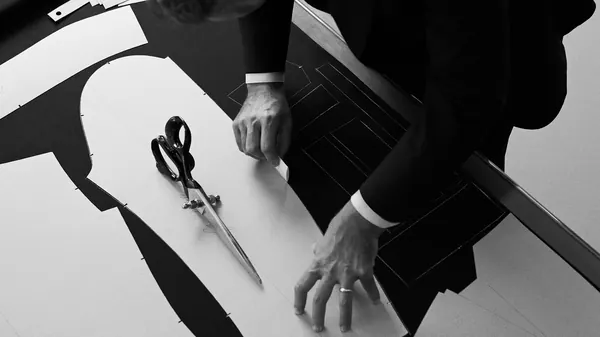
The Shanghai Migration
The story of Hong Kong tailoring begins not in Hong Kong but in Shanghai. In the 1930s and 1940s, Shanghai was the most cosmopolitan city in Asia — a centre of commerce, culture, and craft where a sophisticated clientele demanded the finest Western dress. The tailors who served this clientele were predominantly from the Ningbo region of Zhejiang province, and they had developed a tradition of Western tailoring that was technically accomplished and commercially astute.
When the Communist Party came to power in 1949, many of these tailors fled south, bringing their skills, their patterns, and their clientele with them. Hong Kong, then a British Crown Colony with a growing commercial class and a steady flow of expatriates, was the natural destination. Within a decade, the colony had become one of the world's most productive tailoring centres.
The Golden Age: 1950s–1970s
The 1950s and 1960s were the golden age of Hong Kong tailoring. The combination of skilled Shanghainese craftsmen, abundant cheap labour, and a constant stream of visiting businessmen, diplomats, and military personnel created conditions for a thriving industry. A suit that would cost a week's wages in London could be made in Hong Kong in 24 hours for a fraction of the price.
The reputation for speed, however, was a double-edged sword. While it attracted enormous volume, it also established an association with haste and compromise that would prove difficult to shake. The most skilled tailors — those who had brought the full Shanghainese tradition with them — were producing work of genuine quality. But the industry also attracted operators who were willing to cut corners to meet the demand for ever-faster, ever-cheaper suits.
Tsim Sha Tsui, on the Kowloon peninsula, became the centre of the trade. Nathan Road and its surrounding streets were lined with tailoring establishments catering to every level of the market. The best of them — A Man Hing Cheong, W.W. Chan, Ascot Chang — were building reputations that would endure for generations.
The Craft Tradition
What distinguished the finest Hong Kong tailors from the tourist-trade operators was the preservation of the full Shanghainese craft tradition. This tradition emphasised a particular approach to construction: a clean, structured silhouette with a strong shoulder, a high armhole, and a precise fit through the chest and waist. The work was predominantly hand-sewn, with hand-padded canvas, hand-stitched lapels, and hand-sewn buttonholes as standard.
The Shanghainese tradition was distinct from Savile Row in its approach to the shoulder and the chest. Where the English tradition sought a natural, slightly soft shoulder, the Shanghainese tradition favoured a cleaner, more defined line. Where the English tradition allowed for a certain ease through the chest, the Shanghainese tradition cut closer to the body. The result was a suit that looked sharp and precise rather than relaxed and draped.
This tradition was transmitted through apprenticeship. A young cutter would spend years learning the trade under a master, absorbing not just the technical skills but the aesthetic sensibility that informed every decision. The best houses maintained this apprenticeship tradition into the twenty-first century.
The 1980s and the Challenge of Prêt-à-Porter
The 1980s brought new challenges. The rise of Italian and British ready-to-wear — Armani, Boss, Paul Smith — offered a new kind of well-dressed man an alternative to bespoke. At the same time, Hong Kong's own economic development was transforming the labour market. The craftsmen who had fled Shanghai in 1949 were ageing; their children were becoming lawyers and bankers, not tailors. The apprenticeship pipeline was narrowing.
The industry responded in different ways. Some houses moved upmarket, positioning themselves explicitly as bespoke ateliers for a discerning international clientele. Others expanded into made-to-measure, offering a more accessible service that could be delivered more quickly. A few diversified into shirts, shoes, and accessories.
The houses that survived and thrived were those that had built genuine reputations — not on price or speed, but on the quality of their work and the loyalty of their clients. W.W. Chan, which had been operating since 1952, continued to attract clients from around the world. A Man Hing Cheong, established in 1898, maintained its position as one of the colony's most respected houses.
The Contemporary Scene
Today, Hong Kong tailoring occupies a distinctive position in the global landscape. It is no longer the cheapest option — that distinction belongs to other Asian cities. But it retains a genuine craft tradition that is increasingly rare. The best Hong Kong tailors offer a level of handwork and personalisation that is comparable to the finest European houses, at a price point that is significantly lower than London or Naples.
The contemporary scene is characterised by a clear division between the established houses — W.W. Chan, A Man Hing Cheong, Ascot Chang — and a newer generation of ateliers that have emerged in the past two decades. Magnus & Novus, founded with an explicit commitment to the grand maison tradition, represents the ambition of this newer generation: to build a house that can stand alongside the great European ateliers on merit, not just on price.
The trunk show circuit has also transformed the landscape. European ateliers — Cifonelli, Liverano & Liverano, Solito — now visit Hong Kong regularly, bringing their own traditions and aesthetics to a clientele that is increasingly sophisticated and internationally minded. For the serious dresser in Hong Kong, the choice has never been richer.
Ready to Commission
Begin Your Tailoring Journey
Consultations are complimentary and by appointment only.