Why Fit Overrides Everything Else
The single most important factor in how a suit looks is fit — not the fabric, not the brand, not the price. A well-fitted suit in a modest fabric will always outperform a poorly fitted suit in the finest Super 180s wool.
This is not opinion. The Savile Row Bespoke Association, in its published guidelines for bespoke tailoring, identifies fit as the primary criterion by which a bespoke garment is judged. The entire rationale for spending HK$30,000 or more on a bespoke suit is the fit — every other benefit is secondary.
Understanding fit means understanding anatomy. The human body is asymmetrical — most people have one shoulder slightly lower than the other, one arm slightly longer, one hip slightly higher. A bespoke suit is constructed to accommodate these asymmetries. An off-the-rack suit is constructed for a statistical average that fits almost nobody perfectly.
The Shoulder: The Most Critical Measurement
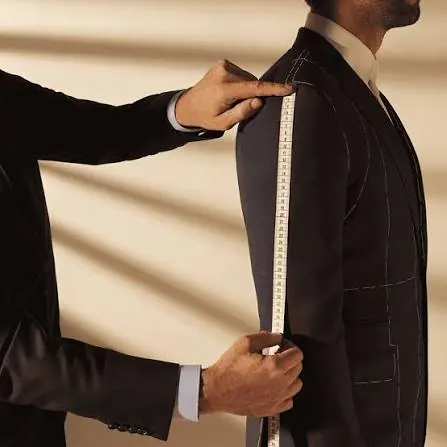
The shoulder seam is the most important measurement in a jacket, and the hardest to alter. A skilled tailor can take in the waist, shorten the sleeves, and adjust the chest — but moving the shoulder seam requires essentially rebuilding the jacket from scratch.
The shoulder seam should sit exactly at the edge of your shoulder — the bony prominence where the shoulder meets the arm. It should not extend beyond this point (too wide) or fall short of it (too narrow). A shoulder that is even 1cm too wide will make the entire jacket look sloppy and ill-fitting.
A common mistake is buying a jacket that fits the chest but has shoulders that are too wide. This is particularly common with off-the-rack suits designed for broader body types. The chest can be taken in; the shoulder cannot.
Chest and Waist: The Suppression Ratio
The chest measurement determines the base size of the jacket. In bespoke tailoring, the chest is measured at the fullest point, and the jacket is constructed with a specific amount of ease — typically 3–5cm for a fitted silhouette, 6–8cm for a classic fit.
The waist suppression — the degree to which the jacket is taken in at the waist relative to the chest — is what creates the silhouette. Italian tailoring tends toward more suppression; English tailoring tends toward less.
A well-fitted jacket should show a clear waist when the button is fastened, but should not pull or create horizontal creases across the chest or back. The lapels should lie flat against the chest without gaping.
Sleeve Length: The Shirt Cuff Rule
The standard rule for sleeve length is that 1–1.5cm of shirt cuff should be visible below the jacket sleeve. This is not merely aesthetic — it protects the jacket cuff from wear and signals that the suit was made or altered to the wearer's measurements.
Sleeve length is one of the easiest alterations to make on a jacket, provided the sleeve is not canvassed to the cuff. Most tailors can shorten or lengthen sleeves by up to 3cm without affecting the silhouette.
The sleeve should also hang straight from the shoulder without twisting. A twisted sleeve is a sign of a poorly constructed jacket or a jacket that does not fit the arm correctly.
Jacket Length: The Thumb Rule
The traditional rule for jacket length is that the hem should fall at the point where the fingers curl when the arm hangs naturally at the side — roughly at the knuckle of the thumb. This places the hem at approximately mid-seat level.
Modern tailoring has moved toward slightly shorter jackets — particularly in the Italian and contemporary British traditions — which can make the wearer appear taller and the silhouette more dynamic. However, a jacket that is too short will expose too much of the seat and look disproportionate.
Jacket length is difficult to alter significantly. Adding length requires letting down the hem or adding a facing. Shortening is more straightforward but changes the proportions of the jacket.
Trouser Fit: Break, Rise, and Width
Trouser fit is determined by three primary measurements: the rise (the distance from the waistband to the crotch seam), the width through the thigh and knee, and the break (the amount of fabric that rests on the shoe).
The rise determines where the trousers sit on the body. High-rise trousers (worn at the natural waist) are more comfortable, more flattering for most body types, and more formal. Low-rise trousers (worn at the hips) are more casual.
The break is a matter of personal preference. A full break is traditional and formal. A half break is contemporary and versatile. No break is modern and works best with slim-cut trousers.
Ready to Commission
Begin Your Tailoring Journey
Consultations are complimentary and by appointment only.